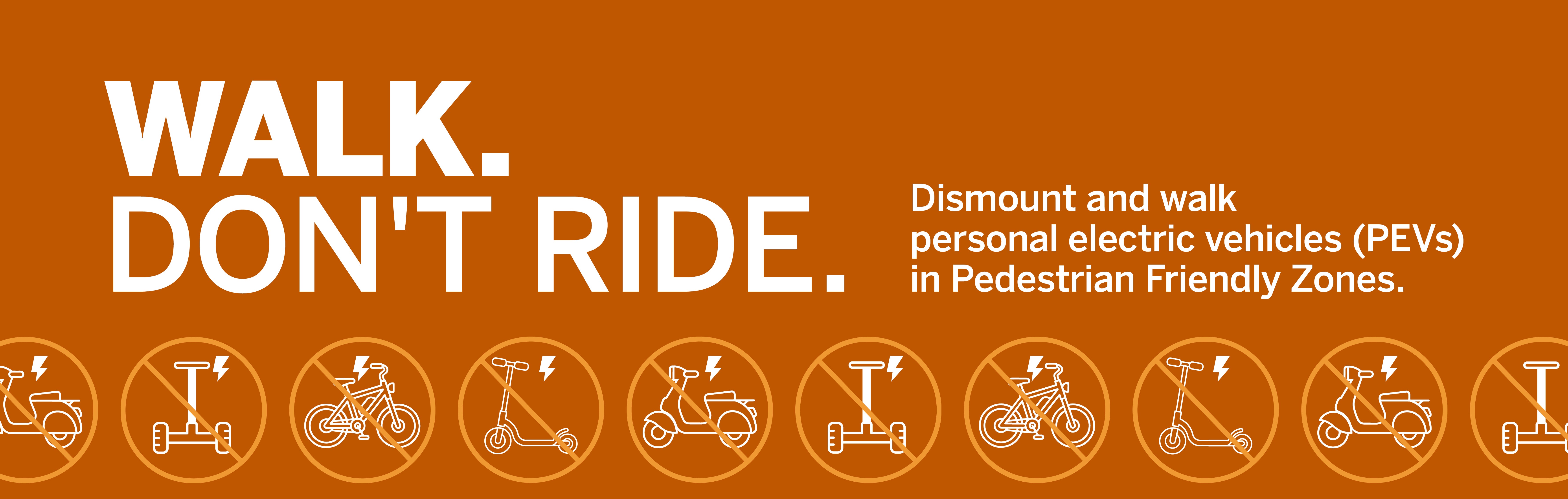
To improve safety and create a more welcoming campus experience in the busiest areas of campus, The University of Texas at Austin has designated a Pedestrian Friendly Zone on main campus that will take effect Aug. 24.
On this page, you’ll find everything you need to know about mobility expectations in the zone, parking areas for scooters and bicycles, and how to register your micromobility device. The following rules and resources prioritize the safety of growing pedestrian traffic on main campus and were made in partnership with the UT Police Department, Campus Safety, and other University offices.
Pedestrian Friendly Zone
Within the Pedestrian Friendly Zone, users of personal electric vehicles (PEVs) must dismount and walk their wheels — not ride — through this high-traffic pedestrian area.
PEVs are compact, battery-powered transportation devices intended for a single rider, such as electric scooters, electric bicycles, electric boards (skateboards, hoverboards, Onewheels), and Segways. ADA mobility devices, such as electric wheelchairs and manually powered mobility aids, may be ridden in the area and are not considered PEVs. Users of traditional bicycles and other self-powered wheeled devices may ride but are encouraged to go slowly in the zone, be mindful of pedestrians, and always obey the rules of the road. Upon entering the zone, Lime and Bird electric scooters will power off, bringing the motor to a safe, gradual stop allowing you to walk it.
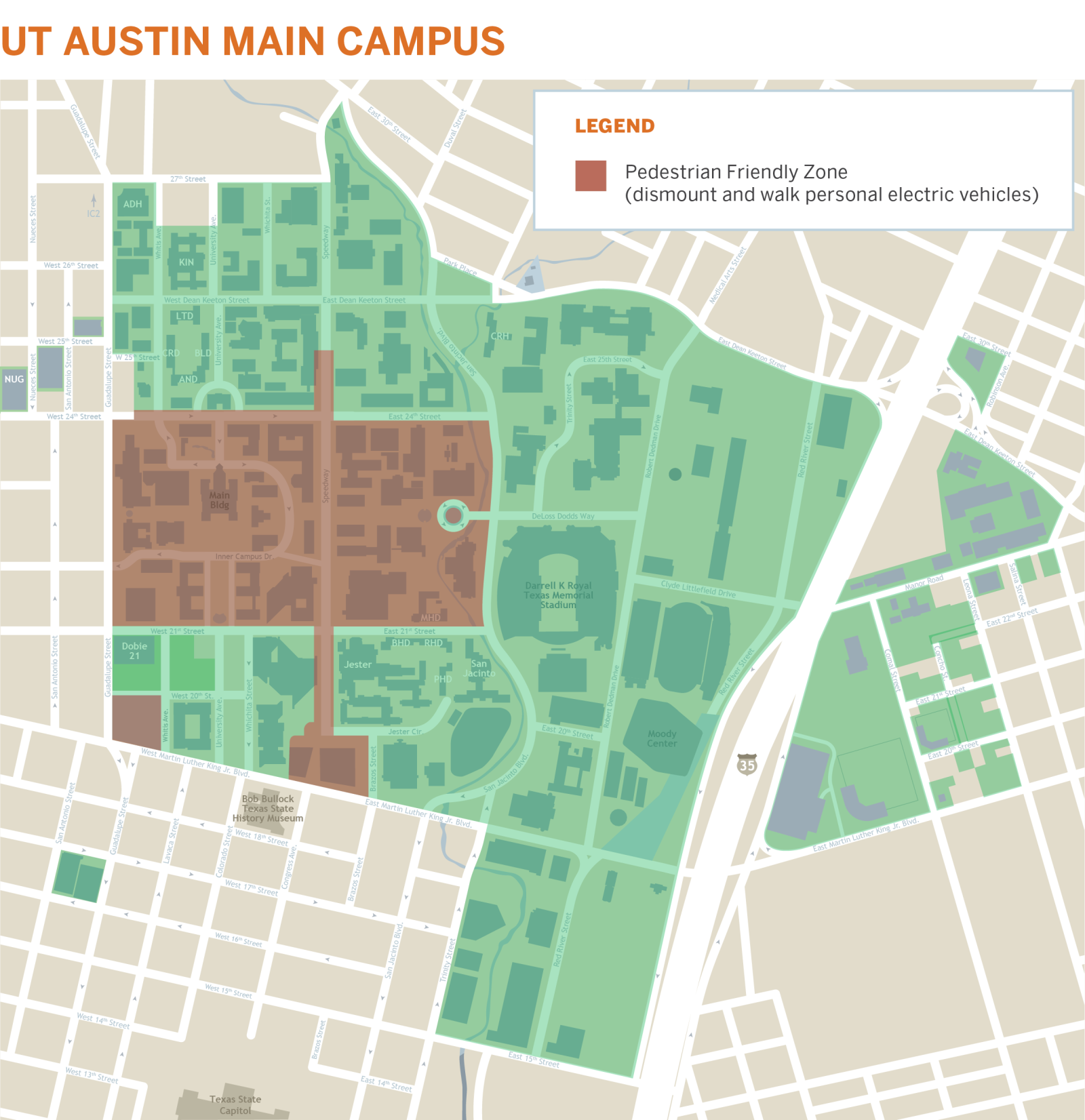
The Pedestrian Friendly Zone includes the area inside San Jacinto Boulevard to Guadalupe Street and 21st Street up to 24th Street as indicated on the following map. The roadways of San Jacinto Boulevard, Guadalupe Street, and 21st Street will continue to allow all forms of traffic. The perimeter will be clearly marked with signage to help our community adjust to the changes.
Please familiarize yourself with the Pedestrian Friendly Zone and allow yourself enough time to get to your destination safely and responsibly. To support safer movement through campus, the University is also adding more bicycle and scooter parking spaces and corrals throughout the campus core. To view current scooter parking areas across campus, visit the Scooter Map.
Map
Rules of the Road
As Longhorns, let’s each do our part to move safely throughout campus and follow these rules:
- Walk, Don’t Ride electric wheels in the Pedestrian Friendly Zone.
- Park Right in designated areas only.
- Stay Alert. Watch out for others and avoid distractions.
- Be Safe. Know speed limits, follow signs, and obey the law.
Register Your Scooter, Bike or other Device
Registration with Parking and Transportation Services (PTS) is required for students, faculty, and staff who bike or ride a scooter, or other form of micromobility device, to campus. When you register your personal device, you’re protecting your ride. Registration helps police return lost or stolen property, deters theft, and lets PTS reach you if it needs to be moved. Registration is free and easy and can be completed online.
Register Your Wheels
Frequently Asked Questions
Q: What is a personal electric vehicle (PEV)?
Personal electric vehicles (PEVs) are compact, battery-powered transportation devices intended for a single rider. The category generally includes electric scooters, electric bicycles, electric skateboards, electric unicycles, self-balancing electric boards (Onewheels), Segways, electric mopeds/sit-down scooters, electric go-karts/drifters, and electric hoverboards. PEVs do not include adaptive devices used for accessibility. Traditional manual wheelchairs, electric wheelchairs, and manually powered mobility aids are not considered PEVs under the law.
Q: How will these mobility changes be enforced?
The University is focused on education, awareness, and helping the campus community learn mobility expectations in the new Pedestrian Friendly Zone through signage, outreach, and communications. The UT Police Department will continue to enforce existing traffic laws, such as obeying all traffic signals and stop signs. The goal is to build a shared culture of mobility safety and encourage everyone to do their part to create a safer campus experience.
Q: If riders of PEVs don’t dismount, will there be a penalty such as a citation?
Our focus is on encouraging safe behavior and positive reinforcement. We know our community wants a safe campus, so we’re optimistic that these changes will create positive behaviors without the need for greater enforcement.
Q: Why do the new safety rules apply to PEVs and not self-powered mobility devices?
Personal electric vehicles (PEVs), such as e-scooters and e-bikes, pose the greatest safety concern to UT’s densely populated campus. PEVs tend to be ridden at higher speeds, left in spaces that violate fire safety codes, and have batteries that pose additional risks in our buildings. The mobility changes we’re implementing are intended to address these challenges and support a campus experience that is welcoming and safe.
Q: Is the University implementing speed limits for PEVs?
Rather than enforce speed limits in high-traffic pedestrian areas, we are asking riders to dismount their personal electric vehicle or turn the battery off and manually ride or maneuver it at low speeds in the Pedestrian Friendly Zone.
Q: Can I still bring a PEV to campus?
Yes, but personal electric vehicles (PEVs) should be parked in designated parking areas and dismounted or maneuvered at low speeds with the battery off in the Pedestrian Friendly Zone. Self-powered wheeled devices such as traditional/acoustic bicycles may be ridden in the Pedestrian Friendly Zone, but users are encouraged to go slowly, be mindful of pedestrians, and always obey the rules of the road, such as stopping at stop signs and going with the flow of traffic, including on one-way roads.
Devices with lithium batteries are not allowed inside campus buildings, including in residence halls.
Q: Does the Pedestrian Friendly Zone apply to wheels used by those with disabilities or accessibility needs?
ADA mobility devices, including traditional manual wheelchairs, electric wheelchairs, and manually powered mobility aids, may be ridden in the Pedestrian Friendly Zone and are not considered PEVs.
Q: What happens if I have a Lime or Bird e-scooter in the zone?
Upon entering the zone, Lime and Bird electric scooters will power off, bringing the motor to a safe, gradual stop. Locking will be disabled so that riders can walk the device out of the zone to resume riding. Check with your preferred scooter company for more on their rental ride policies.
Q: What are the expectations for University fleet vehicles?
Cart and University fleet operators will be asked to use designated parking areas away from the West Mall and other highly used and visible pedestrian spaces whenever operationally feasible.
Q: What other mobility options does the University provide to navigate campus?
Helping students, faculty, and staff navigate around campus safely and securely is a priority for the University. Free transportation options and programs include:
- The UT shuttle system provides an easy and cost-effective way for students, faculty, staff, and visitors to access the UT campus. The 640 Forty Acres and 642 West Campus routes circulate around main campus. UT students, faculty, and staff may ride the shuttles at no charge with a valid UT photo ID.
- PTS Pickup provides courtesy cart transportation to faculty, staff, students, and visitors across main campus, Monday through Friday from 7:30 a.m. to 5:30 p.m. Riders can simply wave down a PTS Pickup cart anywhere along its route for transportation across campus.
- PTS Connect is a PTS-operated shuttle service that connects East Campus Garage and the Student Services Building with frequent service throughout the day. Additional routes connect main campus with Dell Pediatric Research Institute (DPRI) and J. J. Pickle Research Campus (PRC).
- The Sure Walk program offers complimentary late-night cart and car rides, and an accompanied walking service seven days a week from 8 p.m. to 2 a.m. Riders must be picked up at an on-campus location and go to another on-campus location or nearby location according to the service area.
- CapMetro’s Courtesy Stop Program provides shuttle drop-offs after 9 p.m. at safe, well-lit locations.
- UT Night Rides provide late-night (11 p.m. to 4 a.m.) Lyft rides from main campus, UT Dell Campus for Advanced Research in north Austin, or the Dell Pediatric Research Institute (DPRI) to eligible drop-off locations including neighborhoods along UT Shuttle routes (West Campus, Far West, Lake Austin, North Riverside, Lakeshore, Intramural Fields) as well as mainline Route 10 serving the Red River area.